
Every family has one. They are the person who gets handed a set of keys somewhere between the turkey and the pie, because somebody’s check engine light has been on since August and “you know about cars.”
This one is for them, in two parts: a ten-minute check to do on your own car before you drive to Thanksgiving, and a fast way to answer the question you are going to be asked after dinner. At the end, the three shirts we made about it.
Before you drive: a 10-minute pre-trip check
Thanksgiving week is one of the busiest driving weeks of the year, and it lands right when the weather turns. Most of what strands people on the way to dinner shows up in the first cold week of the season. Here is what to look at.
- Set the tire pressure cold. Fill to the pressure on the sticker inside the driver’s door, not the number molded into the tire. Tire pressure drops roughly 1 psi for every 10°F, which is why the low-pressure light so often comes on the first cold morning. If you need a hand, here is how to fill a car tire.
- Check the oil. Engine off for a few minutes, on level ground. Pull, wipe, reinsert, read. Between the marks is fine; near the low mark, top it up with the grade in your manual.
- Look at the battery. Cold is hard on batteries. If it has been cranking slowly or is past four or five years old, get it tested before a long drive. Our guides to charging a dead battery and jump-starting a car are worth a read before you need them.
- Wipers and washer fluid. Replace wipers that streak. Use a winter-rated washer fluid that will not freeze in the reservoir.
- Walk around the lights. Headlights, brake lights, hazards. A dead bulb is a five-minute fix in the driveway; here is how to change a headlight bulb.
- Read any warning lights. If the check engine light is on, find out why before you leave, not on the shoulder.
The check engine light, before and after dinner
The check engine light is a single lamp for hundreds of possible faults. A loose gas cap and a failing catalytic converter turn on the exact same light, and the only way to tell them apart is the code stored in the car’s computer.
- Steady light: a fault worth reading soon, usually not an emergency.
- Flashing light: an active misfire. It can overheat and ruin the catalytic converter. Don’t drive far on it.
Reading the code takes about a minute. Plug a Bluetooth OBD2 adapter into the port under the dash, open a scanner app, and run a scan with the engine on. AXLY shows the code, explains it in plain English, and lets you ask follow-up questions, so you can tell your uncle whether his P0420 is a sensor or a converter without guessing. Step by step: how to read check engine codes on an iPhone.
One warning from experience: clearing the code is not fixing the problem. Clear it without a repair and the light comes back, and the car will show its readiness monitors as not ready, which fails an emissions test. (We made a shirt about that one too.)
So, can you look at my car after dinner?
Yes. That is the whole first design.
The AXLY Thanksgiving drop
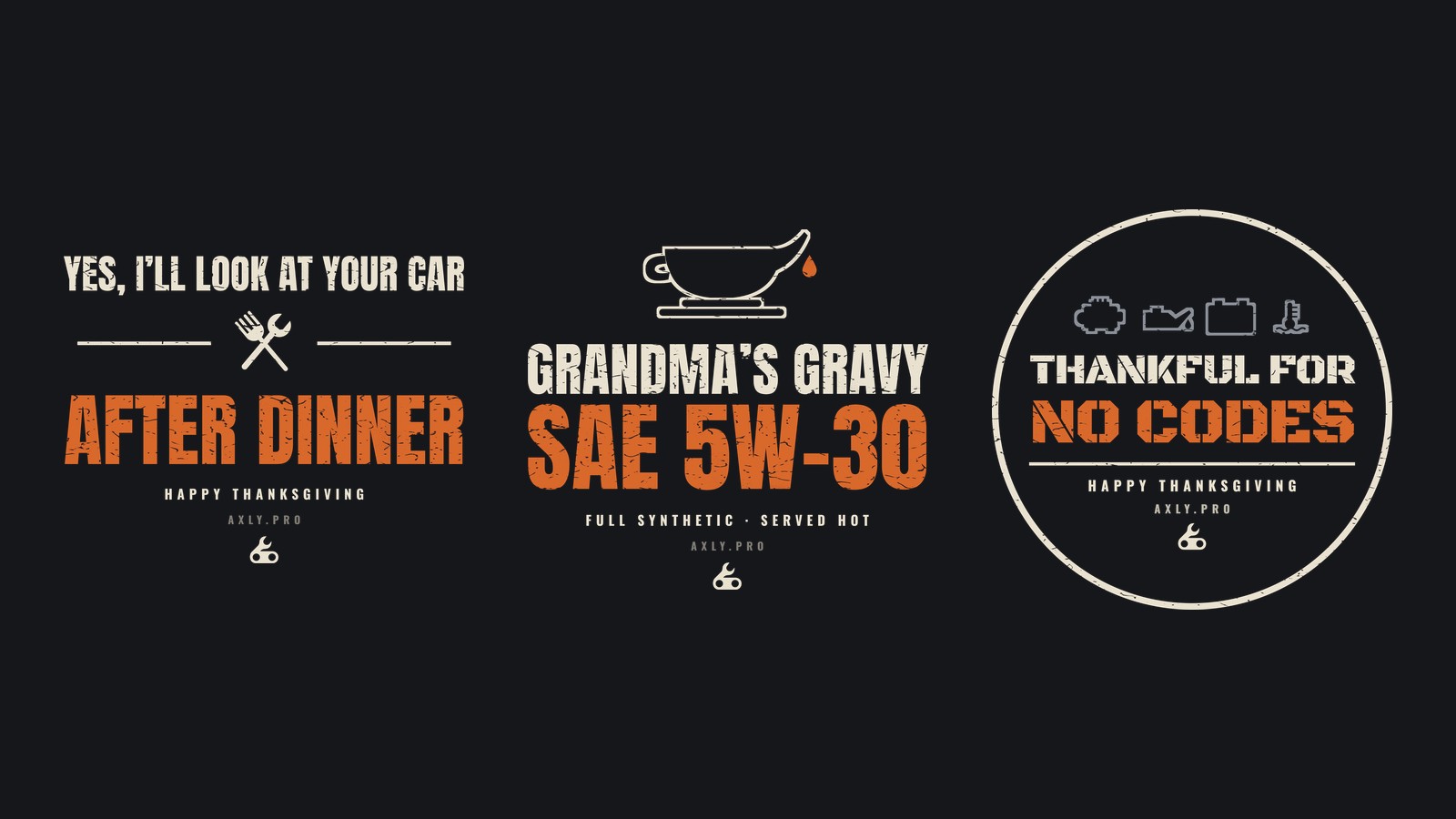
Three new designs for the family mechanic, all with the same worn, cracked print as the rest of the range, on tees, crewnecks and hoodies, plus kitchen and table pieces.
- Yes, I’ll Look at Your Car After Dinner. A fork and an open-end wrench, crossed. The answer every car person gives every year. Shop After Dinner
- Grandma’s Gravy, SAE 5W-30. A gravy boat with a drop of oil coming off the spout. Full synthetic, served hot. Made for the apron. Shop Grandma’s Gravy
- Thankful for No Codes. Check engine, oil, battery and coolant, all dark, inside a ring like one more light on the dash. Shop Thankful for No Codes
 After Dinner Tee $32 · Shop →
 Grandma's Gravy Apron $40 · Shop →
 Thankful for No Codes Hoodie $55 · Shop →
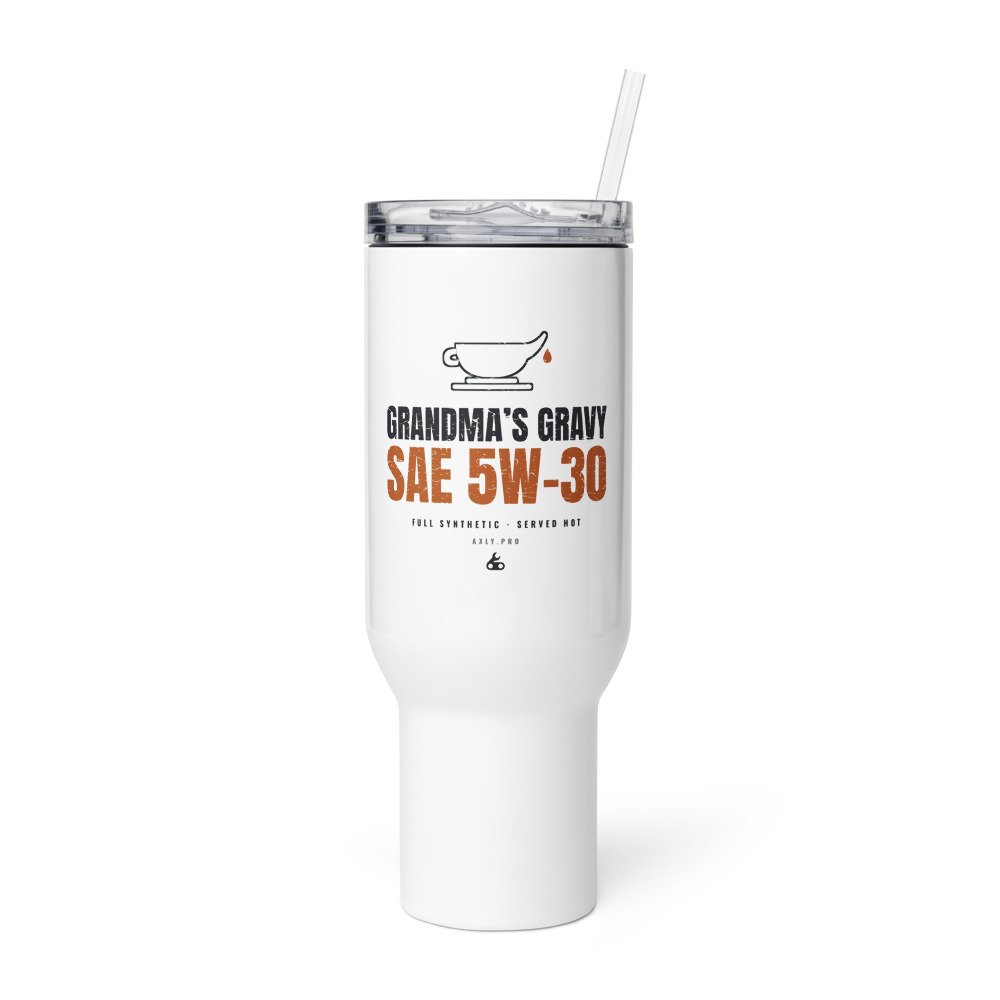 Grandma's Gravy Travel Mug $42 · Shop →
Tees are $32, crewnecks $48 and hoodies $55. Mugs are $20, the 40 oz travel mug $42, the 20 oz tumbler $36, aprons $40 and coasters $10. Shipping is free in the US, and everything is printed when you order, so order by November 16 to have it before Thanksgiving.